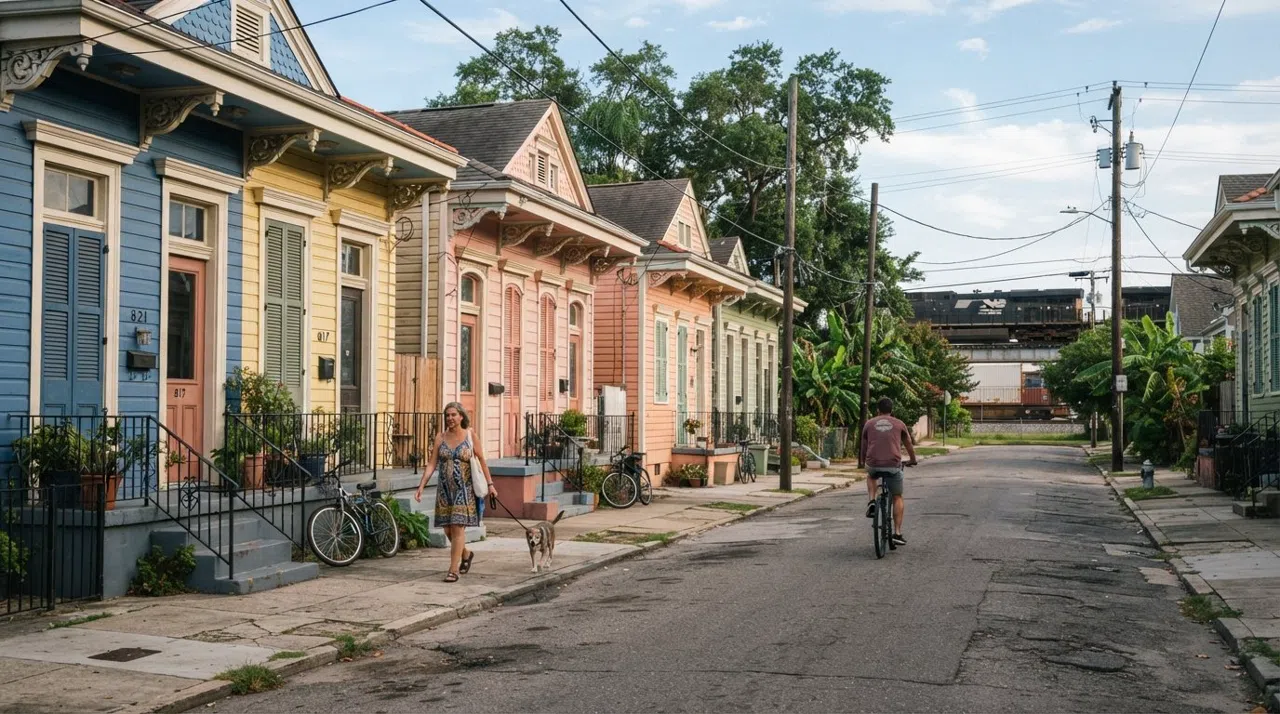
Two blocks off the Mississippi, the freight trains still rumble past murals, coffee roasters and shotgun cottages painted every colour a hardware store sells. That’s the first thing you feel in Bywater: the place is alive to movement, but never in a hurry about it. A bicycle leans against a fence. A porch cat watches the street like it pays rent. Somewhere beyond the next block, a snare drum starts up and a conversation keeps going over the train noise, because in Bywater that is simply how the sentence finishes.
What Bywater is known for
Bywater’s reputation rests on three things, and none of them is subtle: colour, food and river. The colour is right there in the blocks of intact 19th-century shotgun and Creole cottages, painted teal, mustard, hot pink, and the sort of blue that makes you think somebody had a grudge against beige and won. The food is the reason people cross town. The river is the gift at the edge of it all, where Crescent Park gives you a skyline view that doesn’t charge admission and doesn’t ask you to dress up for it.
This was once a working-class, racially mixed downriver neighbourhood tied to the wharves and railroad, and the industrial bones still show if you know where to look: the freight line cutting through the middle, the old warehouses, the flood-wall that keeps the streets politely separated from the water. One of those warehouses is now Studio Be, which tells you everything you need to know about Bywater’s habit of repurposing the hard stuff into something useful and public. Since the 2000s, the neighbourhood has become shorthand for creative, post-Katrina New Orleans, which is both a compliment and a source of friction. The place wears its gentrification openly and a little uneasily. That’s why Dr. Bob’s Be-Nice-or-Leave signs land as a joke and a house rule at once.
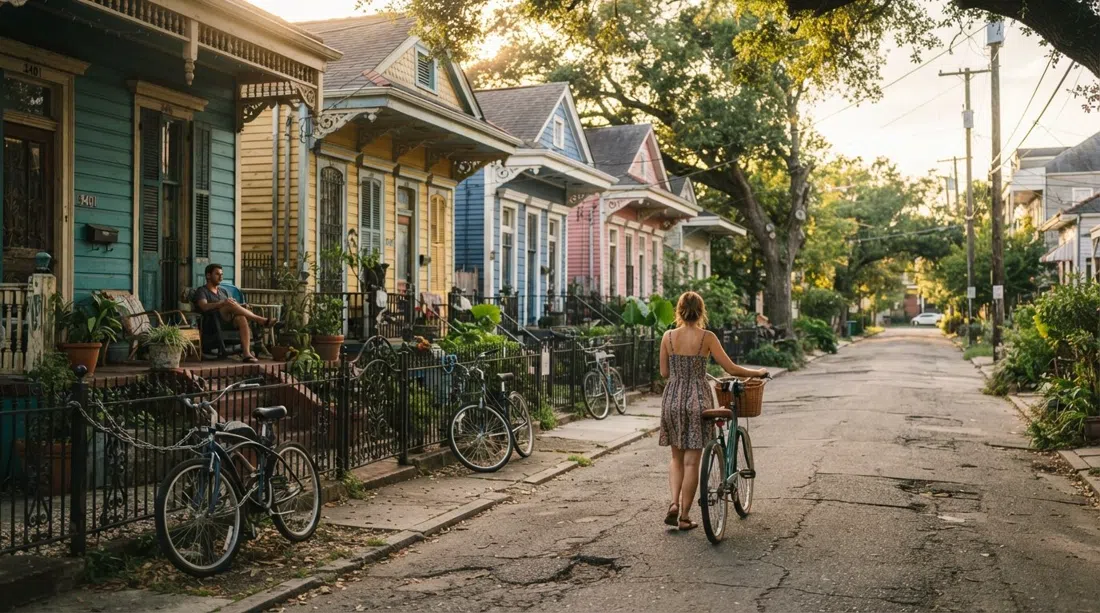
The best thing about Bywater is that it still feels like a village inside the city. Walk a few blocks and you’ll pass chickens in yards, bicycles chained to every fence, murals on blank walls, and people who look like they’ve lived here forever or arrived last Tuesday with a laptop and a good idea. It is residential and unhurried in a way the French Quarter never is. The Quarter performs; Bywater lives. And if you want the neighbourhood in one clean sentence, it is this: a coffee at Satsuma, a king cake from Bywater Bakery, and a sunset over the skyline from Crescent Park can make a whole good day.
Where to eat & drink
Acamaya is the restaurant that put the neighbourhood on even more people’s lips, which is saying something in a city that already talks through food. Ana Castro opened the contemporary Mexican-seafood room at 3070 Dauphine St in 2024 with her sister Lydia, and it promptly picked up a Bib Gourmand in the 2025 Michelin Guide, a two-star New York Times review, and spots on Bon Appétit’s and Esquire’s best-new-restaurants lists. That is a lot of attention for one room, but the cooking earns the noise: al pastor hamachi tostada, masa dumplings with Higgins crab, aguachile verde. Book ahead, and do not arrive pretending the city owes you a table.
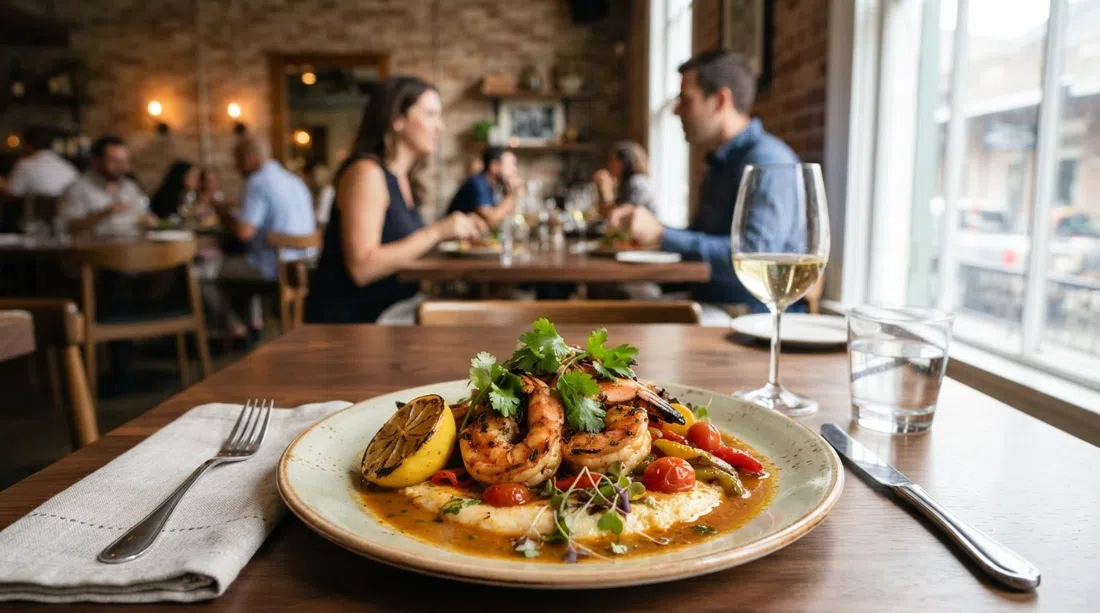
Down the block, N7 hides behind a fence in a garden with almost no signage, which is exactly the sort of move that makes people feel they’ve discovered something. The cooking leans French-Japanese, with tinned seafood and natural wine, and reservations are essential. It is one of those places where the evening slows down as soon as you step through the gate, as if the street noise has been asked to wait outside.
For the kind of dinner that does not require a calendar, Pizza Delicious at 617 Piety St is the neighbourhood standby. The pies are cold-fermented, thin, New York-style, and the whole operation began as a Sunday pop-up by two transplants who understood that a city can forgive a lot if the crust is right. The Joint at 701 Mazant St is the barbecue benchmark here, with ribs, sausage, brisket and a peanut-butter pie worth ordering even if you have already promised yourself restraint. Elizabeth’s at 601 Gallier St remains the brunch institution, and the walls are covered in Dr. Bob’s art, which feels exactly right in a place where breakfast should come with a bit of local mischief. They’re credited with inventing praline bacon, and in New Orleans that kind of claim is either a boast or a civic duty. Sneaky Pickle / Bar Brine at 3200 Burgundy St keeps things vegetable-forward and locally sourced, casual and vegan-friendly by day, a touch more ambitious at dinner.
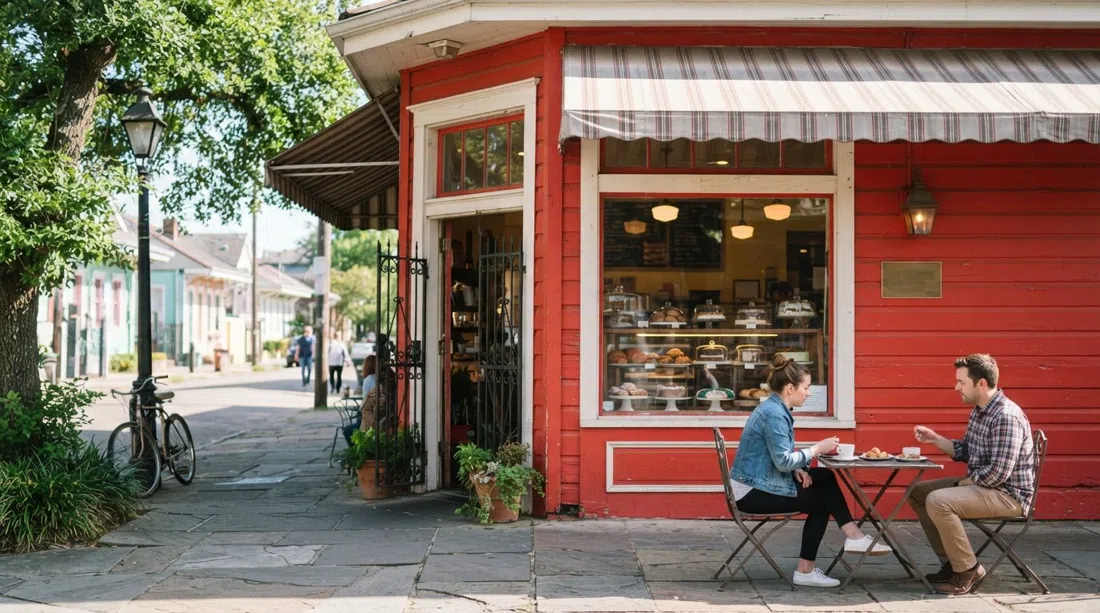
For mornings, Satsuma Café at 3218 Dauphine St is where locals go for coffee, cold-pressed juice and avocado toast in a plant-shaded courtyard. It is less a “scene” than a steady exhale. Bywater Bakery at 3624 Dauphine St handles chantilly cake, pastries and those cult flavoured king cakes that people plan around if they’re smart enough to visit near Carnival. The red-painted corner shop looks exactly like the sort of place that would know what to do with a sugar craving and a line out the door.
Going out
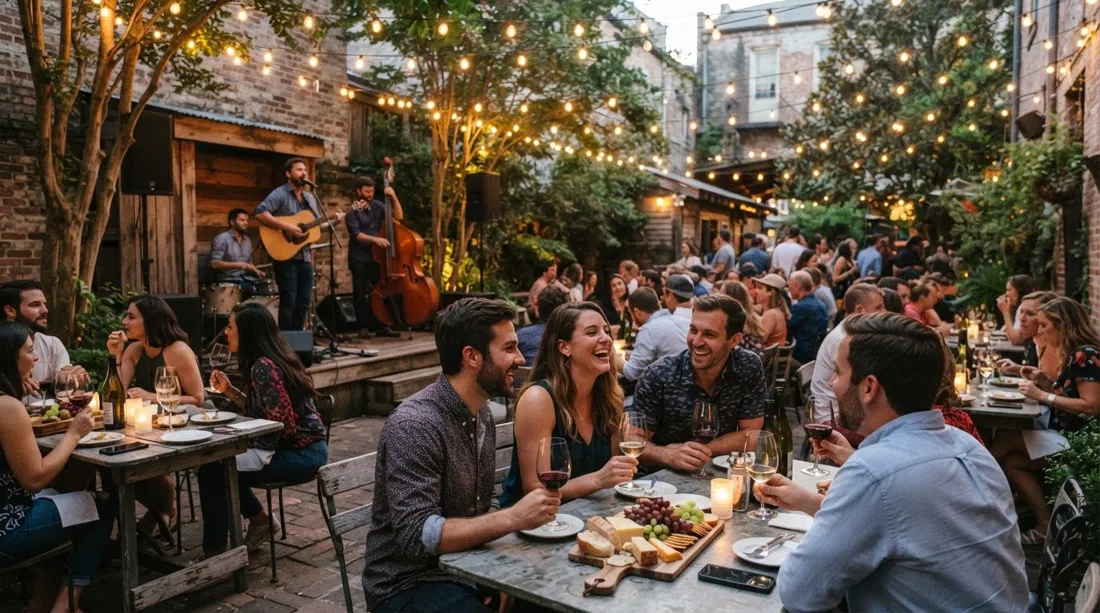
Bywater’s nights run quieter and weirder than the Marigny’s Frenchmen Street strip a mile upriver, and that is part of the charm. The anchor is Bacchanal Wine at 600 Poland Ave, a wine shop since 2002 that grew a courtyard behind it. Pick a bottle inside, carry it out to the backyard, add a cheese-and-charcuterie plate, and let the live music do what live music does best in New Orleans: make strangers behave like a temporary neighbourhood. There’s even a semi-secret cocktail bar upstairs overlooking the crowd, which is the sort of detail that feels earned rather than designed.
For beer, Parleaux Beer Lab at 634 Lesseps St is a small-batch microbrewery and taproom with a repurposed-industrial beer garden, trivia and pop-ups. The name puns on “par l’eau,” by the water, and like the best puns in this city it lands because the place is actually standing in the right geography. It feels made for an evening that starts casually and ends with one more round.
The dive bars are the real nightlife, though. Vaughan’s Lounge at 4229 Dauphine St has been a 9th Ward corner bar since 1959 and is famous for Thursday-night live music; ring the buzzer at the side door and step into a room that knows exactly what it is. BJ’s Lounge at 4301 Burgundy St is the locals’ bar with a jukebox, pool table, back patio and occasional live sets, which is to say it has the essentials and no nonsense. If you want a party with a swimming pool, The Country Club at 634 Louisa St pairs a bohemian pool and bar with a rowdy weekend drag brunch, though you should remember it is 21-plus and book ahead. When you want the full live-music crawl, Frenchmen Street is a short bike ride or rideshare away, but Bywater itself prefers its evenings a little less polished and a lot less loud.
Things to do / what to see
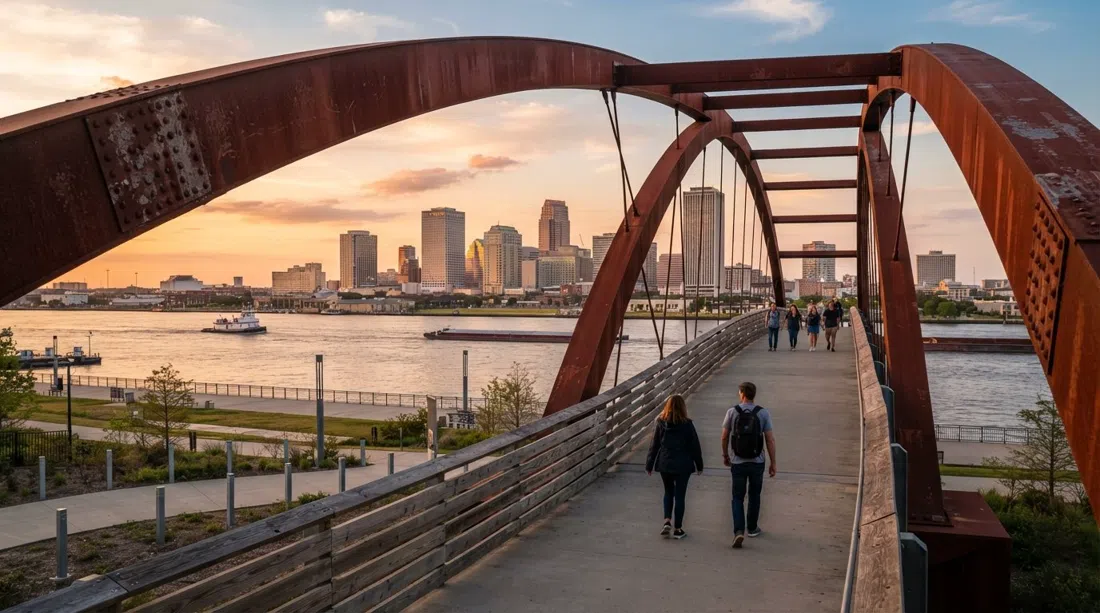
Start at Crescent Park, the 1.4-mile riverfront park built on former wharf land. Cross in over the arching rust-steel pedestrian bridge at Piety Street that everyone calls the Rusty Rainbow, and you get the city’s best free view of the downtown skyline across the water, best around sunset when the towers go soft and the river turns the colour of old pewter. The park runs roughly 6am to 7:30pm, allows leashed dogs, and has step-free access via the elevator near the French Market end. It is one of those rare urban edges that feels generous without trying too hard.
Studio Be at 2941 Royal St is the neighbourhood’s grand indoor wall of feeling: a 35,000-square-foot warehouse gallery of large-scale social-justice murals by New Orleans artist Brandan “BMike” Odums, open Wednesday to Sunday. The place is immense in scale and direct in message, the kind of room that makes you lower your voice without being told. A few blocks over, Dr. Bob Folk Art at 3027 Chartres St is the ramshackle studio behind the ubiquitous “Be Nice or Leave” bottle-cap signs. Wander in, browse pieces from $20 upward, and you may find the artist himself at work. That is Bywater in miniature: art that is public, witty, handmade and slightly ungovernable.
Music lovers should check what’s on at Music Box Village at 4557 N Rampart St, New Orleans Airlift’s outdoor “musical architecture” garden of playable house-sculptures that hosts genuinely strange, wonderful concerts. It is the sort of place that reminds you New Orleans still has room for experiments, not just nostalgia. Between all that, the best thing to do in Bywater is simply walk or cycle the flat streets, following murals and cottage colours block by block.
Shopping & markets
Bywater isn’t a shopping destination in the Magazine Street sense, and that’s the point. Retail here is scattered, independent and half-hidden between the cottages. The most rewarding shop is Dr. Bob Folk Art on Chartres, which works as much like a studio visit as a store, with trademark signs and bottle-cap-framed paintings that run from pocket-money souvenirs to serious collector prices. Studio Be sells prints and merch alongside the murals, which is handy if you want to carry a little of the neighbourhood home without pretending you can buy the mood.
Bywater Bakery doubles as a takeaway counter for cakes and pastries, and its flavoured king cakes are a seasonal buy worth planning around if you visit near Carnival. Otherwise, expect vintage and thrift, small galleries and the odd record or curio shop turning over as leases change. That instability is part of the texture here; the street keeps editing itself. Treat browsing as part of the walk rather than a mission, and if you need something to take away with your evening, Bacchanal is a proper bottle shop as well as a bar.
Where to stay in Bywater
Bywater is a guesthouse-and-cottage neighbourhood, not a hotel district, so the stock skews to short-term rentals, small inns and B&Bs in restored shotgun and Creole houses rather than big-brand towers. That suits its best guests: return visitors and creatives who want a residential, local base and don’t mind a bike or rideshare to the Quarter. The sweet spot is the stretch between St. Claude Avenue and the river, roughly around Dauphine and Chartres, close to the restaurants, Crescent Park and the dive bars while staying walkable and calm. Prices tend to run mid-range and below the Quarter for comparable space, and you get more room and a yard for the money. Book early. The good cottages and the handful of boutique stays go fast, especially around Jazz Fest, Mardi Gras and French Quarter Fest.
If you want to be able to stumble home from live music every night, base upriver in the Marigny or the Quarter instead and treat Bywater as a day trip. Bywater rewards people who like to return to a quieter porch after the trumpet stops.
Getting around
Bywater is flat, compact and made for a bicycle, which is genuinely the best way to cover it. Blue Bikes bike-share and local rental shops both operate here, and residents use bikes as everyday transport. On foot, the core is walkable, though the neighbourhood is spread out enough that you’ll want wheels to reach the far ends around Poland Avenue and Bacchanal.
Public transit is the weak point. The Rampart–St. Claude streetcar, renamed the 46 line and painted purple, runs along the neighbourhood’s upriver edge and terminates at Elysian Fields Avenue in the Marigny, so it drops you near, not inside, Bywater. From there it’s a short walk or the 5 Marigny–Bywater bus deeper in. The French Quarter is about 2 miles upriver, roughly a 10–15 minute bike ride or a quick rideshare, and Frenchmen Street’s music clubs are closer still. Louis Armstrong International Airport is about 25–35 minutes’ drive to the west depending on traffic, so plan on a rideshare or taxi rather than transit to and from the plane.
Bywater is one of the more tourist-friendly, walkable pockets downriver, fine by day and busy with foot and bike traffic in the evenings. Use normal city care after dark and consider a rideshare late at night, because adjacent Ninth Ward blocks are less safe. But that is true of a lot of New Orleans: the city asks for attention, not fear. In Bywater, attention is usually rewarded with a mural, a good plate, or a porch where somebody is still talking as the train goes by.